

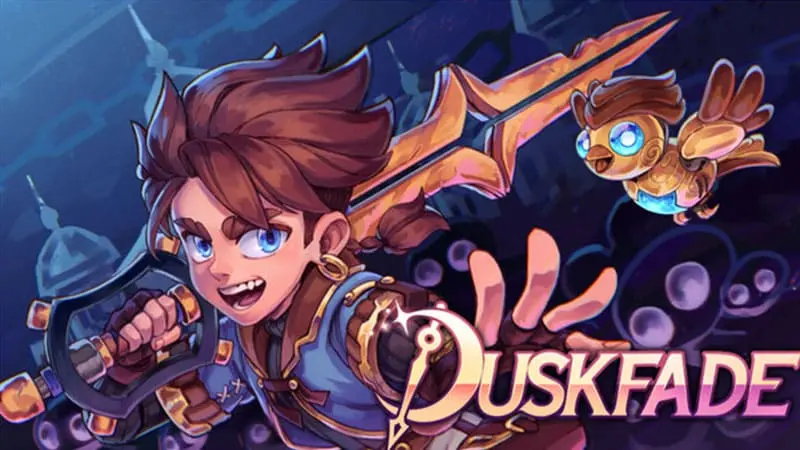
Duskfade makes its influences obvious almost immediately. The oversized weapon, colorful fantasy worlds and expressive character designs can bring Kingdom Hearts to mind, while its movement and level structure lean closer to the 3D platformers that filled the PlayStation 2 era. However, Duskfade works best when it stops reminding you of those games and lets its own movement system take over.
You play as Zirian, a young hero searching for his kidnapped sister after the world is trapped in an endless night. His main weapon, Minutero, is a transforming clock hand that doubles as the centerpiece of the combat system. Cuckoo, a mechanical companion, also joins the journey and helps during battles.
The story keeps things simple, which suits the game well. Duskfade is far more interested in moving you toward the next strange world, platforming challenge or boss encounter than burying the adventure under hours of exposition.
Movement Is Where Duskfade Feels Best
Movement quickly becomes the strongest part of Duskfade. Zirian can jump, double jump, dash, glide, grapple and grind along rails, and these abilities start to flow together naturally once you become comfortable with them.
Later sections are built around chaining these moves rather than using each ability separately. A dash can lead directly into a grapple, followed by a glide toward another platform or a rail that carries you into the next section.
As a result, simply moving through a level can become satisfying on its own.
There is also room to improve. Skilled players can use faster routes and cleaner movement to get through certain areas more efficiently. Time Rifts take this idea further by placing optional platforming and combat challenges throughout the worlds.
Thankfully, mistakes usually feel understandable. Duskfade rarely seems interested in fighting the player with awkward controls. When a jump goes wrong, it generally feels like a missed input rather than the game failing to read what you wanted to do.
Combat Is Simple, but It Has More Depth Than It First Appears
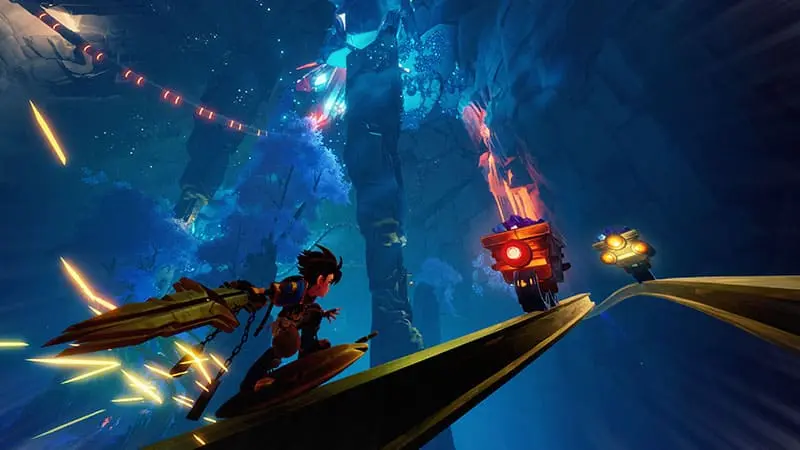
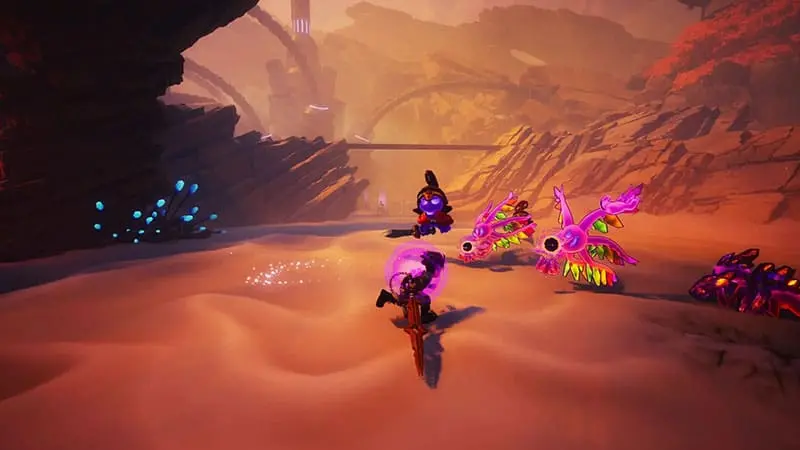
Combat starts with fairly straightforward combos. Minutero handles most of the work, while dodging and positioning become increasingly important as enemy groups grow larger.
However, Duskfade slowly adds new attacks and upgrades instead of throwing an enormous skill tree at you from the opening hour. There is no traditional RPG leveling system either. Progress mainly comes from improving Zirian’s existing abilities, unlocking new techniques and exploring optional areas.
Cuckoo can also be upgraded, including its projectile attacks, giving you another tool during busier encounters.
The system never becomes as complex as a dedicated action RPG, and that appears intentional. Combat works best as part of the wider platforming experience rather than the single feature carrying the entire game.
Boss fights understand this particularly well.
Instead of locking Zirian inside an arena and asking you to repeat one attack pattern, several encounters mix dodging, combat and platforming together. These moments are often where Duskfade’s mechanics feel most complete.
Four Worlds That Actually Change How You Play
Duskfade is not an open-world game. Instead, the adventure moves through four main worlds containing multiple biomes.
That structure helps each area feel more carefully designed. New environments do more than swap grass for sand or change the background color. Different hazards appear throughout the journey, including lava waves, malfunctioning automatons, living chess pieces and platforms distorted by mirages.
These ideas help prevent the platforming from becoming too predictable.
Levels also contain secrets and areas that cannot always be reached during the first visit. After gaining additional abilities, you can return to earlier locations to collect upgrades, cosmetics and other hidden rewards.
It gives exploration a purpose without turning every level into a giant checklist.
The clockpunk art direction also gives Duskfade a recognizable personality. Mechanical cities, oversized gears and strange machines appear throughout the world, while individual regions introduce their own visual ideas.
There are moments where the Kingdom Hearts influence remains difficult to ignore, especially in the character designs. Still, Duskfade gradually creates enough of its own imagery that it does not feel like a simple imitation.
How Does Duskfade Perform on Nintendo Switch 2?
The Switch 2 version is particularly interesting because Duskfade depends heavily on timing and responsive movement.
In handheld mode, the game targets 40 FPS, while docked play targets 60 FPS. The difference is noticeable, especially during fast platforming sequences and sections that require several movement abilities in quick succession.
Docked mode naturally feels smoother and better suited to the game’s fastest moments. However, handheld play remains perfectly usable once you adjust to the lower frame rate.
For a game built around dashing, grappling and precision platforming, consistency matters more than chasing impressive visual effects. Duskfade largely understands that balance.
Its colorful environments also translate well to the smaller screen. Busy scenes can occasionally make platforms and enemies less immediately readable, but the overall visual style remains clear enough during normal play.
It Knows What Kind of Game It Wants to Be
One of Duskfade’s better decisions is its scale.
This is not a 60-hour RPG trying to keep you occupied with endless equipment numbers and side quests. The adventure is built around roughly 15 to 20 hours of platforming, combat and exploration, depending on how much optional content you decide to chase.
Four difficulty settings also make it easier to approach the game differently. Players interested mainly in the world and platforming can keep combat manageable, while higher settings make enemy encounters considerably more demanding.
That flexibility fits Duskfade better than forcing every player through the same level of challenge.
Final Thoughts
Duskfade wears its inspirations proudly, sometimes a little too proudly. Kingdom Hearts, Jak & Daxter and Ratchet & Clank are easy comparisons, especially during the opening hours.
Yet the longer you play, the less important those comparisons become.
Its real strength is movement. Chaining jumps, dashes, grapples and glides across colorful levels gives the game an energy that screenshots cannot really communicate. The combat is less remarkable on its own, but it complements the platforming well, particularly during the better boss encounters.
Duskfade may not completely escape the shadow of the games that inspired it, but it does enough with its movement, world design and clockpunk identity to avoid becoming another nostalgia-driven copy.
On Nintendo Switch 2, it is an especially good fit for players who miss focused 3D platforming adventures and would rather spend 15 hours mastering a fun movement system than 80 hours clearing icons from a map.
Score: 8/10 – Great

