

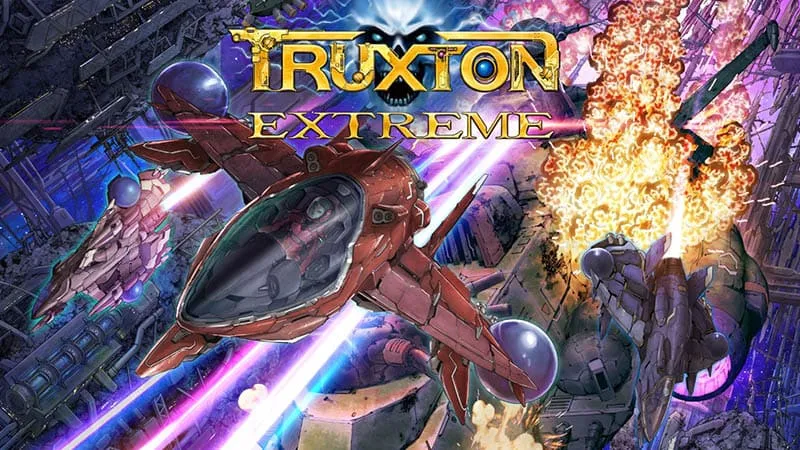
Truxton Extreme arrives more than three decades after the previous game, but it does not feel like a sequel desperately trying to prove that it belongs in the modern era. It knows exactly what kind of game it wants to be. This is still a demanding vertical shooter built around enemy patterns, weapon upgrades and repeated attempts, only now presented with detailed 3D visuals and a far more generous selection of modes.
That traditional approach will not appeal to everyone. Truxton Extreme expects players to replay stages, learn where enemies appear and improve through practice rather than permanent upgrades. For fans of arcade shooters, however, that discipline is also its greatest strength.
Familiar Combat With a Few Smart Changes
The basic structure is easy to understand. Players control a small ship, destroy incoming enemies and collect items that strengthen the currently equipped weapon. Dying removes much of that power, so a single mistake can turn a comfortable run into a desperate fight for survival.
Several weapons are available, and each one fills a different role. Homing Shot makes it easier to deal with enemies approaching from multiple directions, while Truxton Beam concentrates damage directly ahead. Thunder Laser covers a wider part of the screen, making it particularly useful during crowded sections.
Changing weapons during a stage is not always the best decision. A fully upgraded attack can be far more valuable than switching to another option and rebuilding its strength from the beginning. This gives item collection more importance than simply grabbing everything that appears.
The EX meter adds another decision to the usual shooting. It fills as enemies are destroyed and can be spent on a stronger attack that clears threats while generating additional scoring opportunities. Players can use it immediately when the screen becomes dangerous or save it for a larger enemy wave. It is a small addition, but it fits naturally into the existing rhythm.
Truxton’s familiar skull bombs also return. They remain the quickest way to escape a bad situation, although their limited quantity encourages players to hold onto them for bosses. Naturally, this usually means forgetting to use one until half a second after the ship explodes.
The Challenge Feels Demanding Rather Than Chaotic
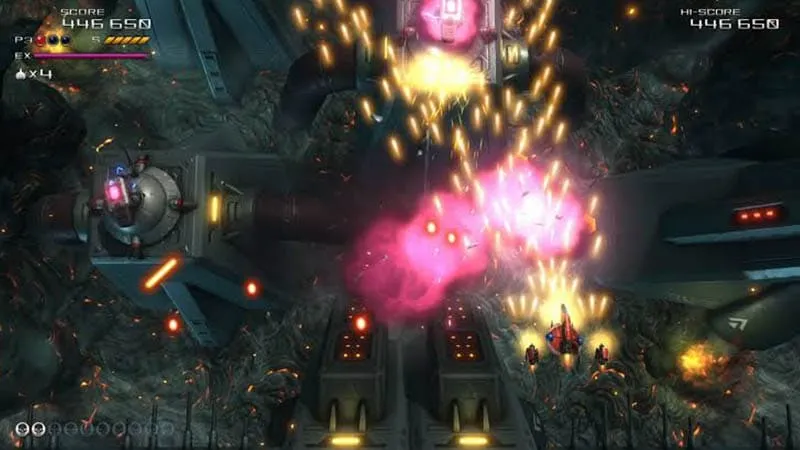
Truxton Extreme is difficult, but it does not rely on filling every inch of the screen with projectiles. Enemy patterns are generally readable, and most attacks give players enough time to react once they understand what is happening.
The real difficulty comes from positioning. Enemies frequently enter from the sides or attack from angles that punish anyone who stays in one place. A failed run often reveals exactly what went wrong, whether it was targeting the wrong enemy or moving into a section of the screen with no safe escape route.
The game also lets players adjust the ship’s movement speed. Faster movement helps collect items and avoid wide attacks, while slower settings provide better control between tightly packed projectiles. Switching speed at the right moment quickly becomes part of the learning process.
The widescreen presentation is slightly unusual for a vertical shooter. Moving toward either side reveals more of the play area, which can initially make the boundaries difficult to judge. It rarely causes serious problems, but players used to traditional narrow arcade screens may need time to adjust.
Boss Battles Provide the Best Moments
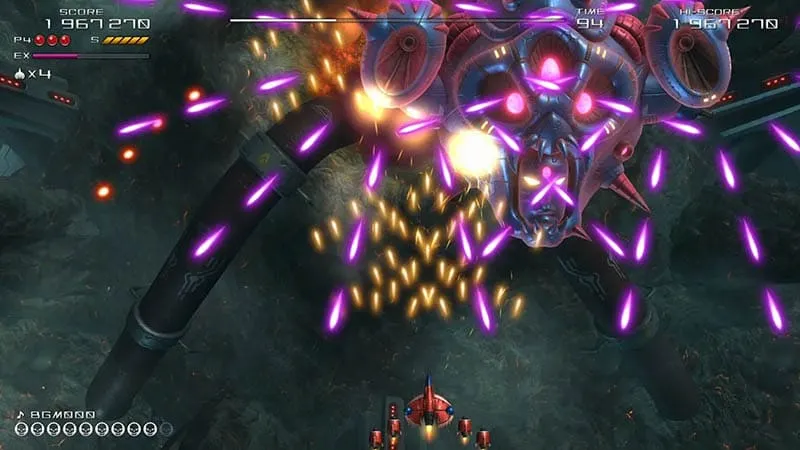
The regular enemy formations are enjoyable, but Truxton Extreme becomes far more memorable during its boss fights. These encounters often fill most of the screen and introduce new attacks as different parts of the machine are destroyed.
Many bosses require more than simply holding the fire button and moving in circles. Some launch objects that can be used as temporary cover, while others force the player to move between different areas of the screen as their attack patterns change.
The 3D presentation works particularly well here. Bosses feel enormous without making their weak points impossible to follow, and hostile projectiles usually remain visible even when explosions begin covering the background.
Checkpoint placement is less successful. Dying close to a boss can send the player back through a section that has already been completed several times. Repetition is expected in this genre, but replaying an easy sequence before every serious attempt adds frustration without improving the challenge.
Story Mode Is Better Than Expected
Story Mode follows three pilots as they fight an alien invasion. The narrative appears through animated comic-style scenes between missions, giving the campaign more personality than the minimal introductions usually found in arcade shooters.
The writing is not especially complex, and the science-fiction story leans heavily on familiar ideas. Even so, the character artwork and presentation make the campaign feel like more than a collection of stages placed beside a menu.
The main problem is repetition. Each pilot moves through versions of the same core campaign, meaning players must revisit familiar locations to unlock every part of the story. Enemy arrangements and difficulty may change, but the routes are not different enough to feel like entirely separate adventures.
Story Mode still works as a welcoming way to experience the game. Players primarily interested in scoring will probably spend more time elsewhere, but the additional context makes the first few runs more engaging.
More Than One Way to Play
Arcade Mode removes the story scenes and keeps the focus entirely on survival and score. This is where experienced players are likely to spend most of their time, particularly once they begin learning stage layouts and competing through online rankings.
Heart Starter Mode is designed for newcomers. It reduces some of the punishment without removing the need to understand enemy patterns. This is a much better solution than simply making opponents harmless, as players still learn the same mechanics they will eventually use in the harder modes.
Arena Mode may be the most immediately replayable option. Its short score challenges remove the slower moments and place players directly into concentrated battles. The brief sessions work especially well on Switch 2 in handheld mode, where it is easy to attempt another run without committing to a full stage.
Local two-player support is also available. Sharing the screen inevitably makes the action busier, but the added chaos suits the arcade spirit of the game. Online cooperation would have been welcome, although online leaderboards at least provide a reason to compare scores with other players.
Training options, tutorials and unlockable artwork complete a package that feels reasonably generous. Most of the additional modes still depend on the same central stages, but there is enough variety to support both short sessions and serious score chasing.
Visuals, Music and Switch 2 Performance
Replacing the older pixel-art style with full 3D graphics was a risky decision. Truxton Extreme avoids many of the usual problems by keeping its backgrounds relatively clean. Enemies and projectiles rarely disappear into the scenery, even during the busiest encounters.
Not every environment is equally memorable. Mechanical corridors and space stations sometimes look plain compared with the impressive boss designs. The game prioritises clarity over visual spectacle, which is probably the correct decision, although some stages could have used more personality.
Fully upgraded weapons create enormous effects that make the ship feel genuinely powerful. These attacks occasionally cover smaller enemies, but the screen remains readable most of the time.
The soundtrack is one of the strongest parts of the presentation. Masahiro Yuge’s music carries the urgency of an arcade shooter without sounding trapped in the past. Weapon effects are equally satisfying, giving every upgrade enough weight to feel meaningful.
Performance on Nintendo Switch 2 remains stable during the action. Even large explosions and crowded boss battles do not noticeably damage the smoothness of the game. Controls also feel responsive, which is essential when small movements can decide whether a run continues.
Loading screens are the main technical weakness. Some transitions last far longer than expected for an arcade shooter built around repeated attempts. They do not interrupt stages, but they make restarting feel slower than it should.
Truxton Extreme Review Final
Truxton Extreme does not reinvent the shoot ’em up, nor does it need to. Its precise controls, destructive weapons and carefully designed bosses prove that the traditional formula still works when handled with confidence.
The game is at its best when a difficult section begins to make sense. Enemy entrances become familiar, bombs are saved for the right moment and a previously intimidating boss finally falls without taking a life. That process of learning and improvement gives the campaign far more value than its relatively small number of stages might suggest.
Repeated Story Mode routes, uneven checkpoint placement and long loading screens prevent the return from feeling flawless. Players with little interest in replaying stages for better scores may also reach the end of their journey sooner than genre enthusiasts.
For anyone who enjoys demanding arcade shooters, however, Truxton Extreme is a strong revival. It respects the identity of the original games while introducing enough modern conveniences to make the series easier to approach.
Score: 8/10
Pros
- Precise and responsive controls
- Powerful weapons with clear differences
- Excellent boss battles
- Strong soundtrack
- Useful difficulty options
- Enjoyable Arena challenges
- Local two-player support
Cons
- Story routes repeat familiar stages
- Some checkpoints waste time
- Loading screens can feel excessive
- Several backgrounds lack personality
- No online co-op

