

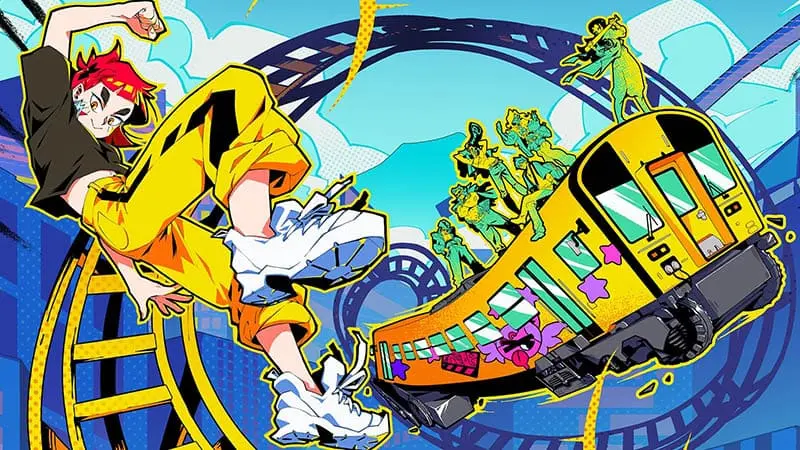
Denshattack! is built around one of those ideas that sounds like a joke until you actually see it in motion. Instead of controlling a skateboarder, you guide a train through jumps, grinds, sharp turns and completely unreasonable aerial tricks. On paper, it sounds like a novelty that might lose its appeal after a few stages. In practice, the game does far more with the concept than expected.
Now available on Nintendo Switch 2, Denshattack! mixes arcade platforming, score chasing and fast reaction-based challenges. Comparisons with Tony Hawk’s Pro Skater and Jet Set Radio are unavoidable, especially when the train starts flipping through the air while loud music and cel-shaded visuals fill the screen. Still, the game is not simply borrowing old ideas and attaching wheels to them. Its structured courses, unusual objectives and exaggerated boss encounters give it a personality of its own.
More Than a Train With a Trick Button
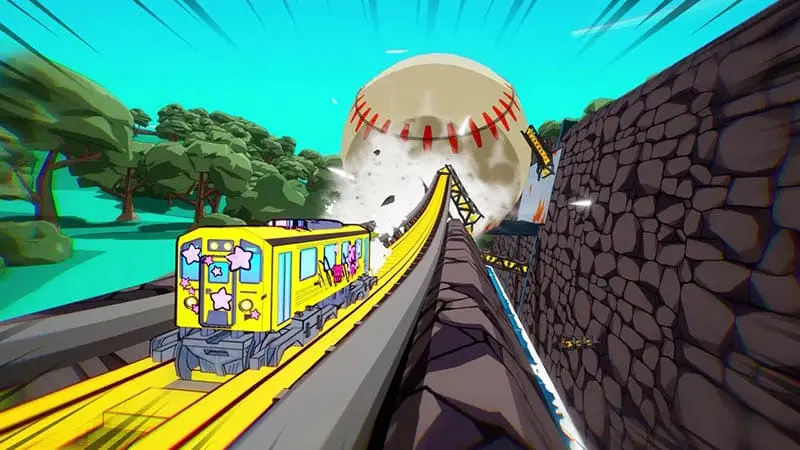
Most levels send Emi and her train through a fixed railway course packed with hazards, alternate rails and opportunities to build a score. Reaching the end is usually the basic goal, but there is often much more to do along the way. Stages include time targets, collectable items, trick challenges and medal requirements that encourage another attempt after the first successful run.
The controls take some time to settle in. Trains are not exactly known for quick platforming, so jumping between rails and drifting around corners can feel strange at first. The game also continues to introduce new abilities as the campaign moves forward, meaning the control scheme becomes busier rather quickly.
Fortunately, failure rarely feels too punishing. A crash normally sends the train back to a nearby checkpoint instead of restarting the whole stage. That makes it easier to learn the route without losing several minutes after every mistake. Simply finishing a course is usually manageable. The real challenge comes from earning better medals, maintaining longer combos and completing every optional objective in one clean attempt.
The game feels much better once the controls stop fighting your muscle memory. A good run is not just about reacting quickly. It is about recognising what the course is asking for before you reach the next obstacle. You begin to remember which corners need an early drift, where a jump must be prepared and which trick can be added without throwing the train into a wall.
That rhythm gives Denshattack! much of its replay value. Returning to an earlier course and cutting down a previous time can be surprisingly satisfying, especially when a section that once felt impossible suddenly becomes easy.
A Colourful World That Rarely Stays Quiet
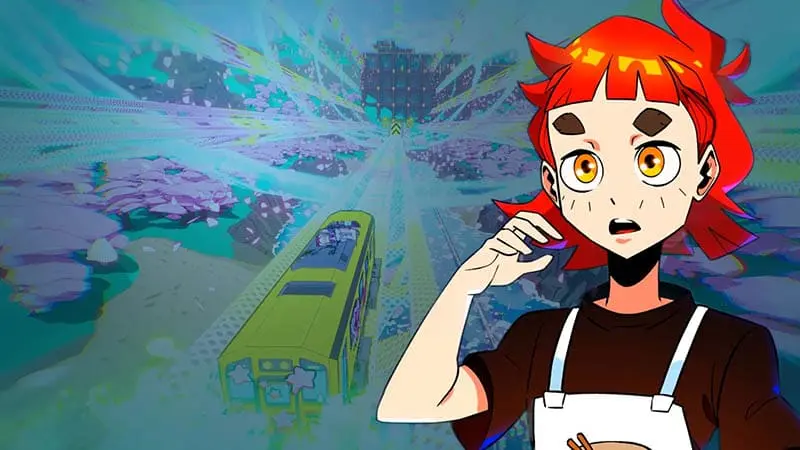
Denshattack Switch 2 takes place in a stylised version of Japan shaped by environmental collapse and corporate control. Wealthy communities live inside protected cities, while those outside depend on abandoned railway systems. Emi eventually becomes involved with groups pushing back against the Miraidō corporation.
The story gives the adventure some direction, although it is not the main reason to keep playing. The world, music and visual design leave a stronger impression. Characters are expressive, menus are loud and the soundtrack rarely allows the pace to drop for long.
The music is especially well matched to the action. Tracks from artists including Tee Lopes, 2 Mello and Shoji Meguro support the game’s mix of speed, rebellion and arcade chaos. Denshattack! clearly understands that a stunt game needs more than responsive controls. It also needs enough energy to make repeated attempts feel exciting rather than mechanical.
The courses help with that. The train passes through cities, countryside, snowy regions and stranger locations that move far beyond ordinary railway scenery. One level might focus on speed, while the next introduces deliveries, puzzles or a large scripted encounter. Boss fights push the idea even further and often feel closer to arcade set pieces than traditional races.
The best thing about Denshattack! is that it never seems embarrassed by its own premise. Once it introduces trains doing tricks, it continues to build on that idea instead of constantly stopping to explain the joke.
The Tracks Can Feel Too Restrictive
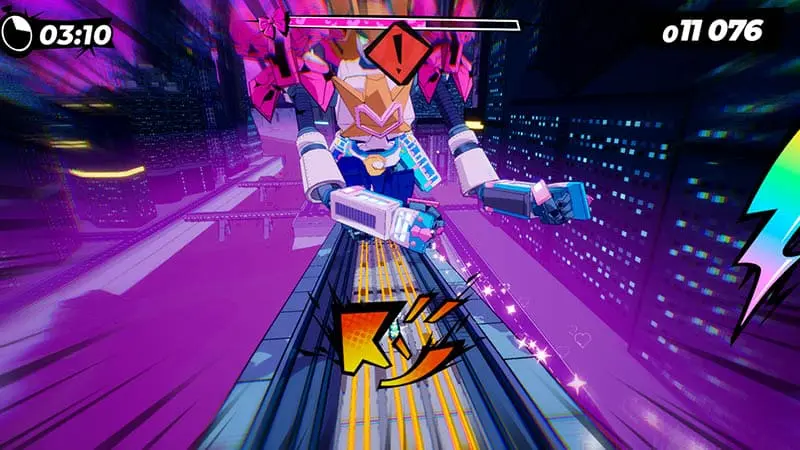
The game’s biggest weakness is also part of its basic design. Most courses follow predetermined routes, so players do not have the same freedom found in a traditional skateboarding game. There are no large parks where you can freely search for the best line or turn the environment into your own playground.
Denshattack Switch 2 usually wants a specific move at a specific moment. Success often comes from learning the intended route and performing it more cleanly on the next attempt. That structure works well for players who enjoy improving times and mastering tightly designed levels. Anyone expecting the freedom of Tony Hawk may find it more restrictive than the colourful presentation initially suggests.
The busiest moments can also be difficult to read. At high speed, the screen fills with rails, effects and moving objects, and it is not always clear which obstacle deserves attention first. Some mistakes feel like the player reacted too late. Others feel more like the camera failed to explain what was coming.
A few sections also lean heavily on spectacle. They look impressive, but player control can feel limited while the game moves through a prepared sequence. Denshattack! is strongest when it gives the player a clear challenge and enough room to improve through practice. It is less satisfying when the action becomes difficult to follow for reasons outside the control system.
Is Denshattack! Worth Playing on Switch 2?
The Denshattack Switch 2 version appears to handle the game’s speed and visual effects well. That matters because even small performance drops could make a fast course feel far more frustrating. Early coverage has generally described the performance as stable, although occasional collision and readability issues have been reported.
The game also suits handheld play. Individual stages are short enough for quick sessions, while medals, collectables and score targets provide reasons to keep playing for much longer. It is easy to finish one course and immediately decide that the previous run was not quite good enough.
Denshattack! will not appeal to everyone. Its controls can feel crowded, its courses are more directed than they first appear and some of its loudest moments sacrifice clarity for spectacle. Those problems are noticeable, but they do not erase what the game gets right.
There are plenty of arcade games built around speed and high scores. Very few let you launch a train into the air, grind across impossible rails and somehow make the whole thing feel coherent. Denshattack! is strange, demanding and occasionally messy, but it is also one of the more memorable games currently available on Nintendo Switch 2.

